







The Chancellor has faced calls to resign over what she told the public and markets about the state of the economy before the autumn Budget
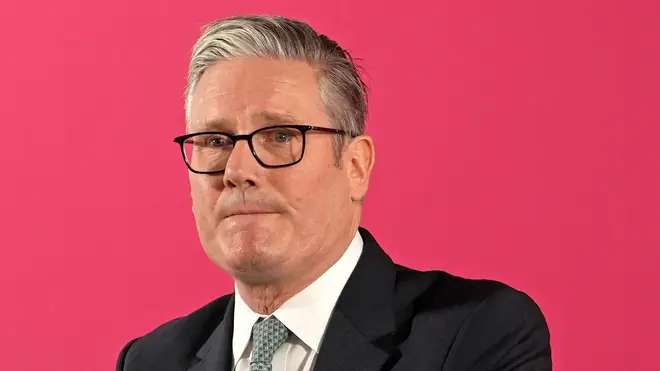
Sir Keir Starmer has rejected claims his Government lied to the public over the state of the nation’s finances in the run up to Rachel Reeves’ autumn Budget.
Speaking today, the PM threw his support behind his Chancellor, hailing the autumn Budget as something his Government should be “proud” of – pointing to a cut in energy bills and the removal of the two-child benefit cap.
The Chancellor has faced calls to resign over what she told the public and markets about the state of the economy before the autumn Budget.
She now faces a growing row over pre-Budget speculation that she faced as much as a £20 billion gap in meeting her fiscal rules, partly as a result of a downgrade in productivity forecasts.
Those rumours were fuelled by Ms Reeves when she used a speech on November 4 to suggest tax rises were needed because poor productivity growth would have “consequences for the public finances”.
When pressed on whether Ms Reeves lied to Cabinet Ministers and the public over the state of the public finances, Sir Keir said: “There was no misleading.”
He told broadcasters he doesn’t accept the framing of suggestions Ms Reeves lied to the public.
“There was no misleading, and I simply don’t accept, and I was receiving the numbers, that being told that the OBR productivity review means you’ve got £16 billion less than you would otherwise have had shows that you’ve got an easy starting point.
“Yes, of course, all the other figures have to be taken into account. But we started the process with significantly less than we would otherwise have had.
He said there was “no pretending” that it was a “good starting point”.
He added: “There was a point at which we did think we would have to breach the manifesto in order to achieve what we wanted to achieve. Later on, it became possible to do it without the manifesto breach.
“Given the choice between the two, I didn’t want to breach the manifesto, and that’s why we came to the decisions that we did.”
Referring to reports of an income tax rise that never came to fruition, he added, “there was a point we might have to reach for a manifesto breach of some significance”.
Speaking at a press conference, the Prime Minister has said growing the economy will require more decisions that are “not cost-free” and “not easy”.
He said: “We have to be clear at this stage of our plan, the most important thing that we can do for growth, the most important thing that we can do for business, is first to drive inflation down so that interest rates come down further still, and the cost of business investment comes down with it and, second, to retain market confidence that allows for real economic stability so that businesses can plan with certainty.
“That is what the country needs most right now.“It is what the Budget secured and that is why our choices were fair, they were necessary and they were fundamentally good for growth.
“But I will level with you as the Budget showed the path to a Britain that is truly built for all requires many more decisions that are not cost-free and they’re not easy.”
He said the UK has passed the “narrowest part of the tunnel”.
“We have now walked through the narrowest part of the tunnel,” he said during a speech in London.


Chancellor of the Exchequer Rachel Reeves speaks to the media as she arrives for the Wales Investment Summit at the International Convention Centre Wales in Newport. Picture: Alamy
He acknowledged that the cost-of-living crisis has not gone away and said: “In the year ahead you will see the benefits of our approach, and not just in the national statistics, but in your communities.”
He added: “Bit by bit, you will see a country that no longer feels the burden of decline, or the sense that things can never get better.”
Pointing to the impact of Britain’s choice to leave the EU, Sir Keir said: “Let me be crystal clear, there is no credible economic vision for Britain that does not position us as an open, trading economy.
“So we must all now confront the reality that the Brexit deal we have significantly hurt our economy and so for economic renewal, we have to keep reducing frictions.
“We have to keep moving towards a closer relationship with the EU, and we have to be grown up about that, to accept that this will require trade-offs.“That applies to our trading relations right across the world, and as you’ve seen already with this Government, there are deals to be done if you’re committed to building relationships.
“That’s what we’ve done with the US, it’s what we’ve done with India, and it’s what we’ve done with the EU and we will keep going
“We will continue to reject drift, to confront reality and take control of our future.”
Sir Keir said he was “bemused”, but not angry at the timing of the Office for Budget Responsibility (OBR)’s productivity review.
The Prime Minister said: “Well, I’m not angry at the productivity review.“It’s a good thing that reviews like that have done from time to time. I’m bemused.
“Myself, I feel that doing at the end of last government and before we started might have been a good point to do a productivity review so we could know exactly what we were confronted with.
“Doing it 15, 16, months into a government, it had to be done sometime, but picking up the tab for the last government’s failure – it’s been the nature of the beast, frankly, for the last 16 months, but it was given a special emphasis in that exercise.
“I’m not angry, I’m just bemused as to why it wasn’t done at the end of the government rather than done now, but I’m not saying that these reviews aren’t important et cetera.”
By Henry Moore