


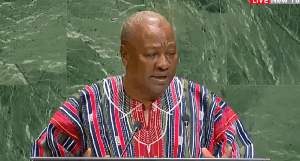
President John Dramani Mahama has delivered a powerful message to world leaders at the 80th Session of the United Nations General Assembly (UNGA), declaring that Africa will no longer tolerate the persistent exploitation of its natural resources.
Speaking in New York on Thursday, September 25, 2025, the Ghanaian leader stressed that the continent must exercise full sovereignty over its wealth to secure the well-being of its citizens.
“The days of parceling out vast concession areas to foreign interests for exploitation must come to an end,” Mahama said.
“We will continue to welcome foreign investment, but we must negotiate better for a bigger share of the natural resources that belong to us.”
Mahama decried the image of Africa as impoverished despite its immense resource base.
“We are tired of the continued image of poverty-stricken, disease-ridden rural communities, living at the periphery of huge foreign-controlled natural resource concession areas. We are tired of having people extract the most they can from us and, in return, offer us the very least by way of respect, consideration, and dignity,” he emphasised.
The President also raised concerns over declining global support, revealing that humanitarian aid to Africa has dropped by 40% since July 2024.
He urged African nations to rely more on their own resources in the face of global uncertainty.
Linking resource exploitation to historical injustices, Mahama repeated his call for reparations. “The slave trade must be recognised as the greatest crime against humanity,” he declared.
“We must demand reparations for the enslavement of our people and the colonisation of our land that resulted in the theft of natural resources, as well as the looting of artefacts and other items of cultural heritage that have yet to be returned in total.”
He insisted that Africa’s contributions and history must no longer be ignored.
“We are tired of not being represented in ways that reveal the richness and complexity of our history or acknowledge all that we have overcome to arrive here, in this liminal space of untold possibilities.”
Placing Africa’s fight within the broader call for reform, Mahama urged the UN to undertake a “reset agenda” that reflects modern realities.
“The UN founding charter is outdated when it comes to representation,” he argued. “If the principle of sovereign equality is to mean anything, Africa with its numerous UN member states must have at least one permanent seat on the Security Council.”
He further criticised global financial systems as unfairly tilted against Africa, stressing the need for greater representation in multilateral institutions.
Closing his address, Mahama reminded the Assembly that Africa’s natural wealth, youthful population, and resilience make it central to the world’s future.
“We are tired of being exploited,” he warned, adding that the continent will continue to demand fairness, dignity, and respect from the international community.