




Major changes to policing will end a postcode lottery for victims of crime, the Home Secretary has said
In what she described as the biggest reform to policing in two centuries, Shabana Mahmood announced more than £140m in new technologies to help catch criminals across the country.
All police forces across England and Wales will be handed AI tools to help cut down crime, she told the House of Commons.
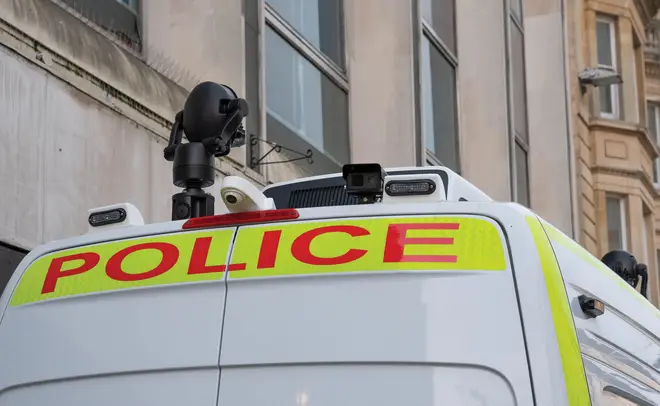
Facial recognition will also be rolled out across England and Wales, bringing the number of vans used from 10 to 50.
Ms Mahmood also promised a neighbourhood officer for every council ward in England and Wales as part of the overhaul.
But the government has not pledged a major increase in the number of warranted officers.
Instead, forces will be merged, starting in the next two years, to bring the total number down from 43 to as few as 12.
A national police service – dubbed the ‘British FBI’ – will take over national responsibilities which ministers say too often take police away from the front line.
Announcing the radical shift in approach, Home Secretary Shabana Mahmood said: “There are uniformed officers who were hired but are stuck behind desks.
“12,000 men and women in uniform are working in support roles, including, absurdly, some 250 warranted officers working in HR.
“I intend to end this by introducing a neighbourhood policing ring fence which will ensure that forces are putting uniformed officers where the public want and need them – out in the community fighting crime on our streets.”
A white paper outlining the government’s plans has pledged to protect neighbourhood officers from routinely being pulled to do other jobs.
Persistent protests have seen thousands of front-line officers being drawn away from their day-to-day roles to manage crowds, especially in London.
Matt Jukes, Deputy Commissioner of the Metropolitan Police, warned LBC that the pressure won’t disappear, even after the reforms have happened, though.
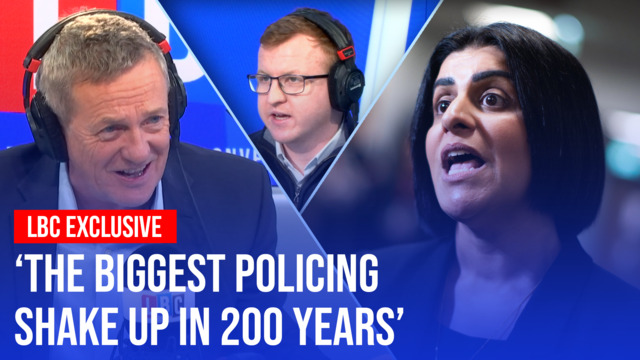
‘Britain’s new FBI’ to include national riot squad tackling public disorder
He said: “Week in week out, thousands of officer shifts are lost in London from local communities into protest activity.
“These are reforms which are very welcome but we are still going to see a Met over the next few years which faces that pressure as the world is more fractured and polarised.
“There are still questions around funding and I am bound to say that London is still under-resourced as a capital city and I would like to see out of this process, everyone gaining confidence that investment in policing really matters.”
The Conservatives have criticised ministers for not focusing on securing an increase in officer numbers, claiming their party would recruit 10,000 more.
Shadow Home Secretary Chris Philp said: “There was no mention, not one word, in her statement for her plans for total police officer numbers.
“They are falling under this Labour government as figures due to be released later this week will confirm.
“They are moving officers away from crime investigation, away from 999 response and away from other teams so they can say neighbourhood teams are going modestly up but total police officer numbers are falling.”
A Home Office source said the government instead wants to make sure police are “in the right places to do the right job”.
A new national police service, expected to be formed after legislation is passed early next year, is set to standardise a number of jobs being duplicated across 43 forces.
Among them is the rollout of new technology like live facial recognition cameras, which the home secretary has said will increase fivefold.
Police forces across England and Wales have access to 10 vans for deployments, which is set to be increased to 50.
The reforms promise a ‘more active Home Office’ when it comes to policing, which will include powers for the home secretary to sack chief constables.
A new commissioner for the National Police Service will also become the most senior officer in the country.
The chair of the Association of Police and Crime Commissioners – who will be scrapped under the plan – has raised concerns that the structure “will place unprecedented power in the hands of just two people”.
Emily Spurrell, the Labour PCC for Merseyside, said: “This concentration of policing power in England and Wales is constitutionally alien and brings enormous risks.
“It must be balanced by robust scrutiny and oversight, involving both local operational leaders and those who are the public’s voice in policing – Deputy Mayors and the successor to Police and Crime Commissioners.”
The Home Office insists that operational independence for police chiefs will be protected and that local leaders will still hold them accountable.
By Fraser Knight and Henry Moore