


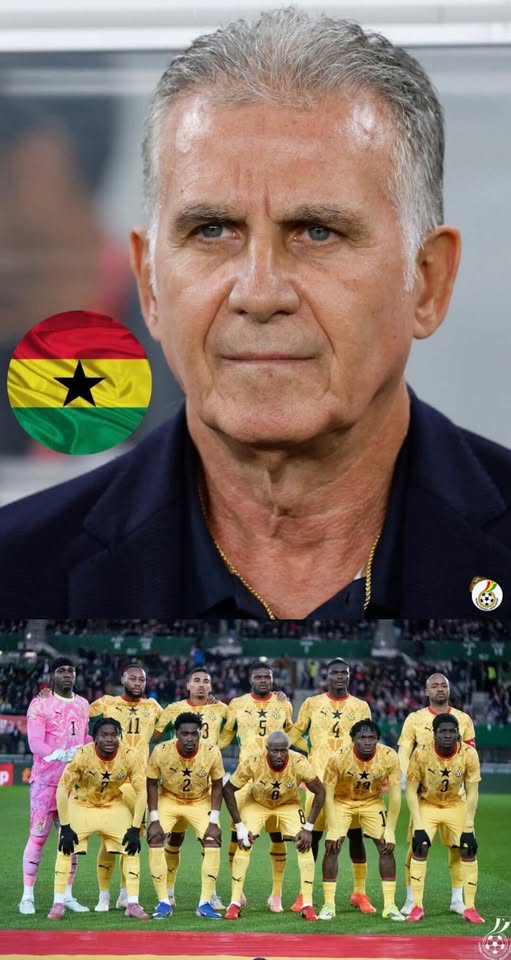
Ghana’s appointment of Carlos Queiroz ahead of the FIFA World Cup is not bold—it is cautious, calculated, and arguably a step backwards for a nation that has long thrived on expressive, fearless football.
There is no questioning Queiroz’s experience. Few coaches in international football can match his résumé. He has managed across continents, led teams to multiple World Cups, and built a reputation as a tactician capable of organising underdog sides into disciplined units. On paper, it makes sense, especially with a major tournament looming.
But football is not played on paper.
Queiroz represents a very specific philosophy: defensive, structured, and risk-averse. That approach has brought him moments of credibility, particularly with Iran, where his teams were difficult to break down and tactically disciplined. Yet even at his peak, his football rarely inspired. It survived, it did not excite.
And that is precisely where the concern lies for Ghana.
This is a team historically defined by energy, flair and attacking freedom. From past generations to the current crop of talent, Ghana’s strength has never been caution—it has been confidence. Appointing Queiroz risks stripping away that identity in favour of a system built on containment rather than expression.
Yes, Ghana are in a difficult World Cup group. Yes, organisation and experience matter. But at what cost?
Queiroz’s recent record offers little reassurance. Short-lived spells, inconsistent results, and a failure to leave a lasting impact in several roles raise legitimate doubts about whether he is still evolving as a coach or simply relying on an outdated blueprint. At 73, this does not feel like a forward-looking appointment. It feels like a safety net.
And safety nets rarely win tournaments.
There is a strong argument that Ghana have prioritised short-term stability over long-term progress. Instead of investing in a modern, progressive coach who could build a clear identity, they have turned to a managerial “firefighter”—someone brought in to steady the ship rather than steer it into new waters.
That may make Ghana harder to beat. But it may also make them easier to forget.
Ultimately, this is a high-risk decision disguised as a safe one. If Queiroz succeeds, it will likely be through discipline and narrow margins. But if he fails, the criticism will be clear: Ghana did not lose trying to be themselves—they lost trying to be something they are not.
And that, perhaps, would be the biggest failure of all.
Successes
• Tournament experience (elite level)
Managed multiple countries at the FIFA World Cup
Known for handling high-pressure international tournaments
• Defensive organisation
Builds teams that are:
Hard to break down
Tactically disciplined
Especially effective with underdog teams
• Iran legacy (his peak)
Turned Iran into a competitive, structured side
Consistently challenged stronger nations
• Talent development (early career)
Won 2 FIFA U-20 World Cups with Portugal
Helped develop a generation of top players
Failures
• Negative / defensive football
Often criticised for:
Lack of attacking creativity
Low-scoring teams
Can make teams too cautious
• Poor club management record
Failed at Real Madrid
Struggled with star players and attacking systems
• Inconsistent recent results
Short, underwhelming spells with:
Colombia
Egypt
Qatar
Oman
• Limited World Cup success
Few wins despite many appearances
Rarely progresses deep into tournaments
• Outdated approach?
Criticism that his methods:
Haven’t evolved with modern football
Focus too much on defence over balance
Bottom line
Strength: Makes teams competitive quickly
Weakness: Limits attacking potential
In one sentence:
A master of organisation, but not of inspiration.