


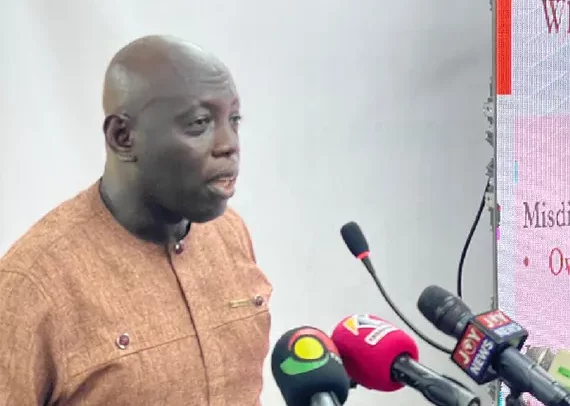
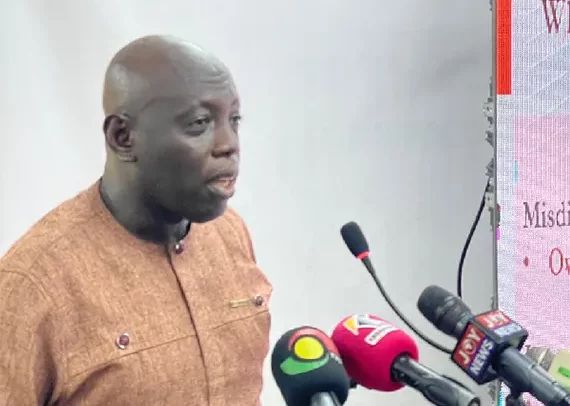
Prof. Isaac Boadi
The Institute of Economic Research and Public Policy (IERPP) has criticised duty bearers, political actors, and especially civil society organisations (CSOs) for their continued silence in the face of the growing destruction of the country’s natural resources.
Speaking at a press conference in Accra yesterday, the Executive Director of IERPP, Prof. Isaac Boadi, said despite clear evidence of the country’s natural resources being exploited illegally, CSOs have been overly quiet for the past fifteen months since the National Democratic Congress (NDC) assumed power.
Describing the CSOs as “voices of conscience”, Prof. Boadi said though they are present in the country, between January 2025 and April 2026, Ghana witnessed at least 15 major incidents of illegal resource exploitation, spanning the Eastern, Western, Ashanti, Savannah, Western North, and Upper East regions.
“Why has there been a deafening silence on the political and civil society fronts in the face of such documented destruction? The deafening silence from political actors and the muted response of major CSOs, in the face of over US$2.5 billion in annual losses, contaminated rivers, destroyed forests, and a looming national water crisis, represent a governance failure of historic proportions,” he pointed out.
The Executive Director stated that the incidents have primarily been driven by illegal small-scale gold mining (galamsey), illegal timber trafficking, and the degradation of the country’s river systems and forest reserves.
He also described the financial and environmental toll of the illegal activities as staggering, adding that all the activities cost the country over US$2.5 billion annually alongside an additional US$200–300 million lost each year to illegal timber trafficking.
“In total, these environmental damage has been equally severe. Between 60 and 75 percent of Ghana’s water bodies have been contaminated, including major rivers like the Pra, Ankobra, Offin, Birim, Tano, Densu, and Black Volta. Satellite imagery and field investigations have confirmed that arsenic levels in some of these rivers are up to 4,000 percent above safe limits, leaving Ghana Water Company Limited (GWCL) unable to treat water effectively at several facilities,” he disclosed.
He added that deforestation has reached alarming levels as of August 2025, noting that 45 of Ghana’s 288 forest reserves had been ravaged, with more than 5,000 hectares permanently destroyed, describing the Western Region as the brunt of the destruction.
Prof. Boadi indicated that one of the key barriers to addressing the crisis is the political support many illegal mining operations appear to receive.
He said despite President Mahama’s admission in December 2025 that party affiliates and traditional authorities are involved in the galamsey menace, even in his own home district of Bole, no politically connected individuals have been prosecuted in connection with the destruction of the environment.
He stated, “Even more concerning are reports of police complicity. In February 2025, three journalists from Citi FM, Angel TV, and ABC News were violently attacked by galamsey operators at a forest reserve while under police escort. Despite witnessing the attack, police officers did nothing, and the suspects were later granted bail.”
Prof. Boadi noted that while civil society organisations such as the Ghana Coalition Against Galamsey (GCAG), A Rocha Ghana, and the Ghana Journalists Association (GJA) have issued public statements condemning the destruction, their interventions have largely been limited to demands and criticisms, with little to no follow-up action.
He said recent events have raised further concerns about CSOs’ lack of engagement, citing the controversial acquisition of Damang Mines by Engineers and Planners Company Limited (E&P), owned by President Mahama’s brother, Ibrahim Mahama.
He stated, “Even more concerning are reports of police complicity. In February 2025, three journalists from Citi FM, Angel TV, and ABC News were violently attacked by galamsey operators at a forest reserve while under police escort. Despite witnessing the attack, police officers did nothing, and the suspects were later granted bail.”
Prof. Boadi noted that while civil society organisations such as the Ghana Coalition Against Galamsey (GCAG), A Rocha Ghana, and the Ghana Journalists Association (GJA) have issued public statements condemning the destruction, their interventions have largely been limited to demands and criticisms, with little to no follow-up action.
He said recent events have raised further concerns about CSOs’ lack of engagement, citing the controversial acquisition of Damang Mines by Engineers and Planners Company Limited (E&P), owned by President Mahama’s brother, Ibrahim Mahama.
Prof. Boadi alleged that the acquisition process was shrouded in secrecy, leading many Ghanaians to question its legitimacy.
He added that despite widespread public interest in the issue, civil society organisations have remained silent, fueling suspicions and raising questions about their role in holding the government accountable.
“The deafening silence from political actors and the muted response of major CSOs, in the face of over US$2.5 billion in annual losses, contaminated rivers, destroyed forests, and a looming national water crisis, represent a governance failure of historic proportions.
“Without an independent prosecutorial unit, a fully funded monitoring framework, and genuine political will to name and prosecute the kingpins, Ghana risks the permanent loss of the very resources upon which its economy and people depend,” Prof. Boadi added.
By Ebenezer K. Amponsah