







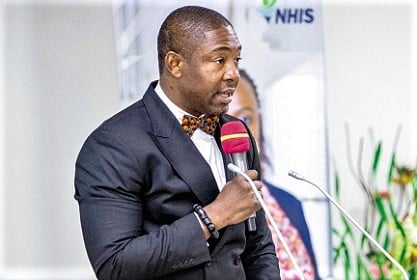


Unpaid bills from emergency departments are the main reason nearly 70% of hospitals slide into debt or shut down, former Health Minister Bernard Okoe Boye has disclosed.
Dr. Okoe Boye explained that emergency units are inherently high-risk financial areas.
They provide life-saving care immediately, often without guaranteed payment, which exposes both private and quasi-public hospitals to large amounts of bad debt.
In an interview on Saturday, 21st February 2026, he said that, beyond challenges with infrastructure and equipment, the healthcare sector struggles with a financing system that forces emergency referrals, pushing many hospitals into unsustainable debt.
“Beyond the concerns of infrastructure and the lack of equipment, a major issue in the sector is health financing,” he stated.
To illustrate his point, Dr. Okoe Boye cited the case of an accident victim rushed to Focus Hospital, a private facility with highly trained specialists and advanced capabilities.
According to him, despite the hospital’s ability to handle complex emergencies, patients are often required to make substantial deposits sometimes as high as GH¢50,000 before treatment can proceed.
“If nobody can raise that amount of money for you, Focus Hospital would like to move you to Ridge Hospital because that is a government facility,” he explained.
He noted that public hospitals such as Ridge Hospital operate at comparatively lower costs, and in cases where bills become bad debts, the government may absorb part of the financial burden.
Dr. Okoe Boye further revealed that nearly 70 percent of hospitals that fall into debt distress or shut down do so largely because of unpaid bills accumulated at emergency units.
“That department is one of the places where you can build a lot of debt if you don’t get a lot of bailout,” he said.
He stressed that emergency care, by its nature, cannot be delayed pending financial clearance yet private facilities operating under strict financial models struggle to sustain prolonged unpaid care.
The former minister also referenced Bank Hospital, describing it as one of Ghana’s best-equipped hospitals comparable to facilities in the United States.
However, despite being built by the government, he explained that the hospital runs on a self-financing model and must generate its own operational funds. As such, deposit requirements remain standard practice.
Similarly, he noted that some patients initially admitted to private facilities are later transferred to Police Hospital not due to lack of expertise or equipment, but because families are unable to sustain the financial demands of care.
“In this case, the referral is not because they do not have the expertise and equipment, but because of finance,” he emphasised.
As a policy solution, Dr. Okoe Boye proposed the creation of a dedicated emergency healthcare fund financed partly through motor insurance contributions.
“Going forward, when we pay motor insurance, a percentage should be put into a fund like the Mahama Care Fund — where any emergency case can be handled at any private hospital, at least for a number of days,” he suggested.
He argued that such a mechanism would allow accident victims to receive immediate life-saving interventions at private facilities without being transferred prematurely due to financial constraints.
“If your life could have been saved, the agreed time could at least save you,” he concluded.
TAGGED:Bernard Okoe-Boyehospitals debt
SOURCES:The Ghana Report