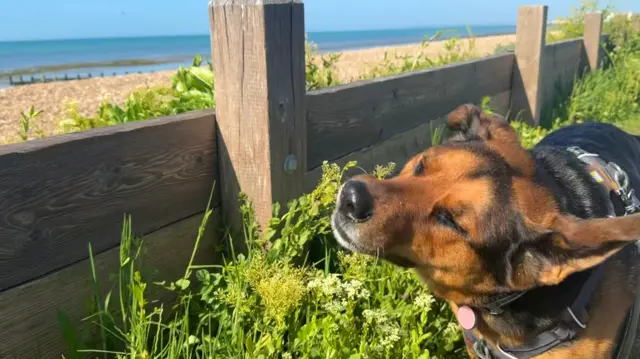



1. How hot will it get this weekend?published at 15:1115:11Simon King
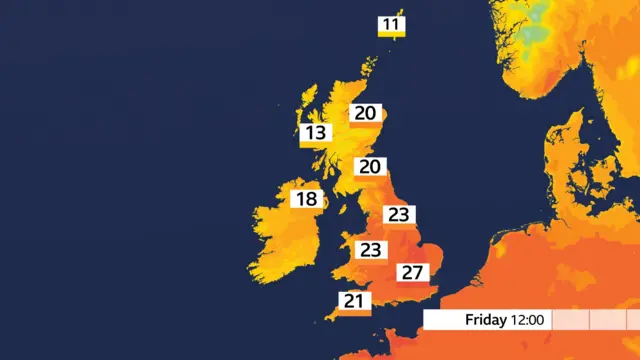
    Lead weather presenter, BBC WeatherLooking ahead to this weekend, temperatures are set to soar across most of England and Wales so that by Sunday they will be into the high 20s.The hottest weather will be across eastern and south-eastern parts of England.There’ll also be lots of strong sunshine with unusually high UV.If you’re heading to a beach then coastal areas will be slightly cooler and it’ll continue to be significantly cooler across Scotland and Northern Ireland where there won’t be a heatwave.However, it will warm up later in the week ahead.Share
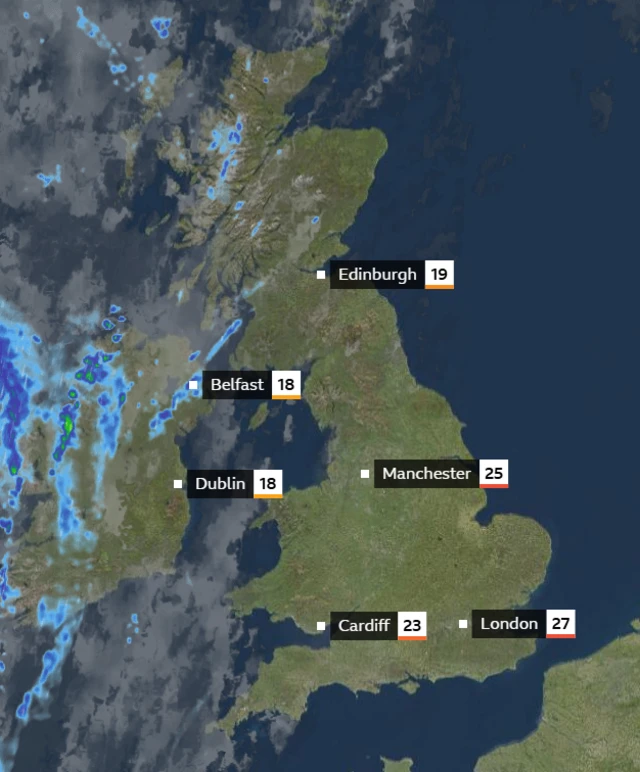
  2. A temperature check, as UK sees warmest day of 2026published at 15:0515:05We’ve just ticked past 15:00 BST and temperatures have continued to climb across parts of the UK.It’s officially the warmest day of the year – that milestone was reached when Heathrow hit 26.9C.The latest temperature recorded for London is 27C, whereas Belfast and Edinburgh are experiencing cooler weather.Here’s a closer look at the picture across the UK:London: 27°CManchester: 25°CCardiff: 23°CEdinburgh: 19°CBelfast: 18°CShare
  3. A stylish pooch and an icy treat: Your pictures of the sunny weatherpublished at 15:0015:00The sun is out, and so are BBC Weather Watcher’s cameras.From dogs, to statues, to sheep, here’s a look at some of your pictures from across England.Among the photos are some pooches basking in the sunshine – here’s a link to our earlier post on keeping them safe in warm weather.Image source,littleacorns/BBC Weather WatchersImage caption,An icy treat seems to have gone down well with this dog in WarwickshireImage source,Sunny Sim/BBC Weather WatchersImage caption,Over at the Chelsea Flower Show in London, this statue of Mother Nature looks glorious in the sunshineImage source,Bettys Hot Spot/BBC Weather WatchersImage caption,A trip to the seaside in Suffolk wouldn’t be complete without a pair of sunglassesImage source,Little Leo/BBC Weather WatchersImage caption,It isn’t sweater weather, but a woolly coat isn’t stopping these sheep from soaking up some sun in KirkleesShare
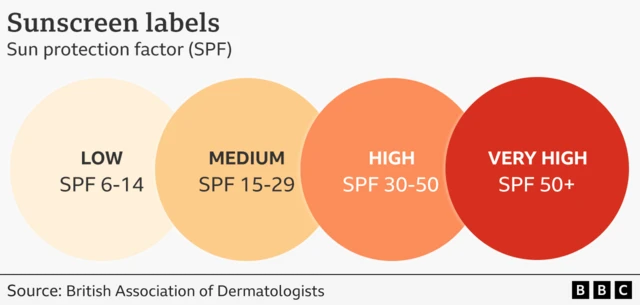
  4. Sunscreen – what you need to knowpublished at 14:3814:38Image source,Getty ImagesAs the weather heats up you might find yourself reaching for your sunscreen.The most prominent number on sunscreen bottles is the sun protection factor or SPF. The larger the number, the greater the protection.According to the British Skin Foundation,, external the SPF rating tells you how much protection your sunscreen provides from ultraviolet B rays.For instance, correctly applying sunscreen with an SPF of 30 it means that it would take your skin 30 times longer to go red than if you used none.Many sunscreen brands also carry a star rating from one to five.The NHS says, external the star rating measures the amount of ultraviolet A protection, with more stars denoting increased protection. It recommends using sunscreen with at least four stars.If the letters “UVA” appear inside a circle on the sunscreen bottle, the product meets EU safety standards.Ideally, your sunscreen should have both a high SPF rating and a high star rating. The NHS recommends that adults use around six to eight teaspoons of sunscreen if they are covering their entire body.Share
  5. Top tips from the NHS for staying safepublished at 14:1514:15Image source,Getty ImagesA heatwave can be dangerous for your health.The NHS warns that during a warmer spell of weather more people than usual get seriously ill or die.It says the biggest risks are:Those over the age of 75, especially women, are the most at risk, the NHS says.Others at risk include those with long-term illnesses, babies and those who find it hard to keep themselves cool, those who work outside and homeless people.To manage the risks, it advises:
    • Staying out of direct sun between 11:00 to 15:00
    • Wearing sunscreen, a hat, and light clothing
    • Consuming cold food and drink
    • Avoiding alcohol, caffeine and hot drinks
    • Closing windows during during the day and opening them at night and using an electric fan to circulate the air
    Share
  6. Want the latest forecasts at your fingertips? Download the BBC Weather apppublished at 13:5813:58Image source,Getty ImagesFor the latest forecasts on the conditions outside, download the BBC Weather app.It’s easy to do – just follow the relevant link for your device:The app is only available to download in the UK.You can also check out the weather in your area by entering your UK town, city or postcode on the BBC Weather website.Share
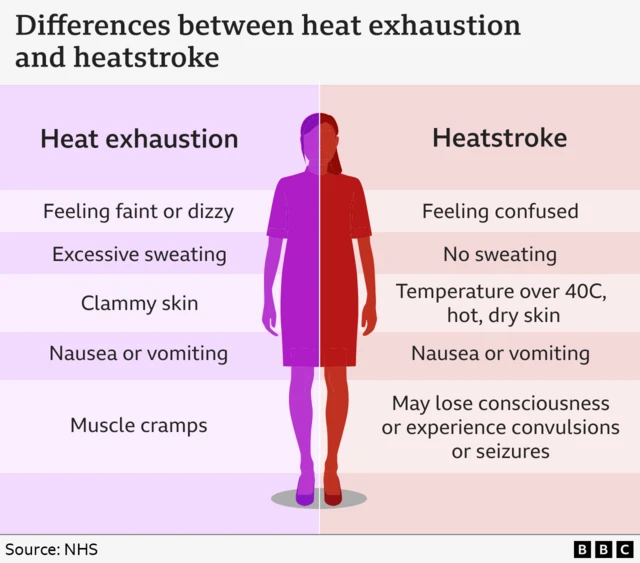
  7. Heat exhaustion and heatstroke – how to spot the signspublished at 13:4913:49Heat exhaustion happens when your body becomes too hot and struggles to regulate its temperature.An obvious sign is excessive sweating, as well as feeling very hot and unwell – which is your body’s way of warning you to cool down, fast.Other symptoms include headache, dizziness and cramps, but it is not usually serious as long as you can cool yourself down.Heat exhaustion can turn into heatstroke, which is a medical emergency. It means your body can no longer manage the heat and your core temperature is rising too high. You should get urgent medical help.The signs to watch for and quickly act on include not sweating even while feeling too hot, a temperature of 40C or above, a seizure and lack of consciousness.Share
  8. How unusual is this heat?published at 13:3713:37Mark Poynting
    Climate reporterImage source,SunshineDan/BBC Weather WatchersIt can be easy to forget just how quickly the UK’s climate is changing.Days exceeding 30C – known as “very hot” days by the Met Office – might feel normal, but they used to be much rarer.As a reminder, Heathrow reached 26.9C earlier, making it the warmest day of the year so far. Temperatures are forecast to reach up to 33C in parts of the UK over the bank holiday weekend.During the last decade, the number of these “very hot” days more than trebled compared with the 1961-1990 average, according to the Met Office.And these temperatures are especially rare in May.The Met Office says that 30C has been reached in May in only a handful of years since 1900.And forecasts suggest that the current May record of 32.8C could be beaten over the upcoming bank holiday weekend.The UK’s weather varies a lot naturally, but this early season heat is consistent with the long-term trend of rising temperatures because of human-caused climate change.Share
  9. The signs your dog is too warm, and what RSPCA says to do if they’re in troublepublished at 13:2513:25Sean Dilley
    BBC News correspondentImage source,LISA SINNOTT/BBCAs a guide dog handler of 27 years, my heart falls every time I hear the fatigued pants of dogs in heatwave weather.Animal welfare charity the RSPCA says that dogs are 10 times more likely to suffer heat-related illnesses from exercising in hot weather than from overheating in cars. Both are tremendously bad for your dog.Canines have a very limited ability to regulate their temperature. They don’t sweat like humans – only perspiring a small amount through the pads on their paws.Heavy panting, difficulty breathing, excessive drooling, lethargy and drowsiness are all key signs that your dog is too hot. In extreme cases, dogs vomit and finally lose consciousness.If your dog is in trouble, the RSPCA says, external you should move the dog to a shaded and cool area and immediately pour cool, but not very cold, water over the dog, avoiding their head.Share
  10. Shake, paddle and shade: Dogs keeping cool during sunny weatherpublished at 13:1913:19For these dogs, a walk by the water has been a key part of the day.Whether it’s by the beach, river or canal these pictures from BBC Weather Watchers show the pooches basking in, or finding shade from, the sun.Keeping cool is essential for dogs in the warm weather. Remember, start with shorter walks and don’t push your dog if they are panting heavily.In our next post, we’ll bring you information from the BBC’s Sean Dilley on the RSPCA’s guidance on keeping dogs safe in the warm weather.Image source,Claire and Bella/BBC Weather WatchersImage caption,A walk on the coast in Middleton-on-Sea, West Sussex, for this four-legged friendImage source,Helen Earth/BBC Weather WatchersImage caption,It’s a paddle in the river for this dog in Cropwell Bishop, NottinghamshireImage source,littleacorns/BBC Weather WatchersImage caption,This pooch in Southam, Warwickshire, has found a shady patch to cool downShare
  11. It’s not all sunshine, parts of the UK remain cloudy and downcastpublished at 13:0013:00Simon King
    Lead weather presenter, BBC WeatherImage source,Rusty Sam/ BBC Weather WatchersImage caption,Cloudy skies in Port Glasgow, Inverclyde, just before middayHeathrow has recorded the warmest temperature of the year so far, but not all parts of the UK are experiencing the warm weather.While a heatwave is expected in parts of the country this weekend, cloudier skies across Scotland and Northern Ireland mean temperatures will only get between 17 to 22C at best.This will fall well short of the threshold needed to declare an official heatwave – 25C for three days in a row.But spare a thought for those in the Northern Isles, Scotland, where it’s even cooler. The maximum temperature today and over the weekend is only going to be 11 or 12 degrees.Share
  12. Heat warnings in place on warmest day of the year – what’s the latest?published at 12:5212:52Nabiha Ahmed
    Live reporterImage source,PA MediaIt’s the warmest day of 2026 so far, and temperatures are likely to rise even further throughout today.In Heathrow, temperatures ticked up to 26.9C, slightly above the previous record of 26.6C in London’s Kew Gardens on 8 April.Here’s what you need to know:Heat warningsThe UK Health Security Agency (UKHSA) has upgraded their heat health warnings covering large parts of England.Amber warnings have been issued in the East and West Midlands, London, East England and South East England – which means the conditions could impact the whole population in these regions, as well as the NHS and likely travel disruption.Yellow heat warnings are in force in North East England, North West England, Yorkshire and Humber and South West England. A yellow warning indicates adverse weather likely to affect vulnerable groups.All warnings are in place until Wednesday 27 May at 17:00 BST.How can I stay cool?We’ve put together a handy guide on how to stay cool in the coming days.There’s also some specific advice on how to tackle hot temperatures depending on your plans: whether it be staying at home, travelling on the train, or catching the football this weekend.The forecast:Bank holiday Monday could see the UK’s hottest day in May ever, as there is increasing confidence that the maximum temperature could reach 33C.Over the next five days, the country will be hotter and drier than parts of the Mediterranean and North Africa.And, here’s a fuller forecast of the days to come.Share

  13. Temperatures are the highest they’ve been this year – let’s look at the picture across the UKpublished at 12:3312:33Simon King
    Lead weather presenter, BBC WeatherIt’s getting very warm out there this lunchtime.With 26.9C just recorded at Heathrow, it is now the warmest day of the year so far.We’re expecting temperatures to rise even further so we’ll be able to let you know how hot it eventually gets later this afternoon.Elsewhere across the UK, temperatures have been rising into the twenties.But with more cloud around the far west of south-west England, west Wales and northern Scotland, temperatures are much lower at 11-14C. Northern Ireland is also cloudy, but seeing slightly higher temperatures.Share
  14. Warmest day of 2026 so far in UK as temperatures hit 26.9C in Heathrowpublished at 12:2012:20BreakingIt is officially the warmest day of the year so far in the UK, the Met Office has confirmed, as temperatures hit 26.9C in Heathrow.Previously, the warmest day of 2026 was on 8 April, when heat of 26.6C was recorded in London’s Kew Gardens.Share

  15. How climate change makes hot weather more likelypublished at 12:1512:15Mark Poynting
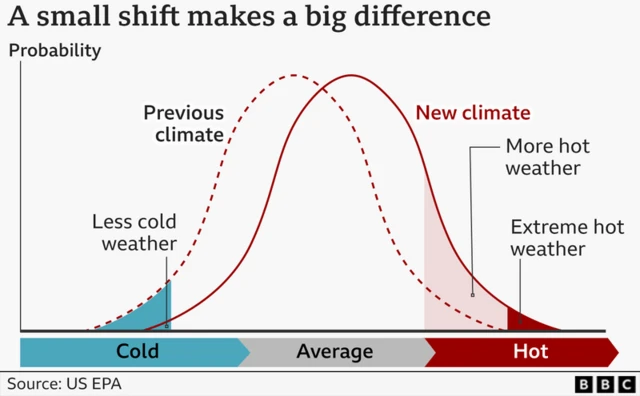
    Climate reporterLet’s step away from the UK for a moment, to understand why we are seeing such high temperatures.It’s well established that human-caused climate change is making hot weather more likely and more intense.As humans burn coal, oil and gas and cut down forests, carbon dioxide and other greenhouse gases are released into the atmosphere.These gases act like a blanket, causing the planet to heat up.And even a small increase in average temperatures makes a big difference to heat extremes.As the range of daily temperatures shifts to warmer levels, hotter days become more likely and more intense.Since the 1980s, the UK has been warming at about 0.25C per decade – and 2025 was the UK’s hottest year ever recorded, the Met Office says.
Leave A Reply

WP Radio
OFFLINE LIVE
Exit mobile version