







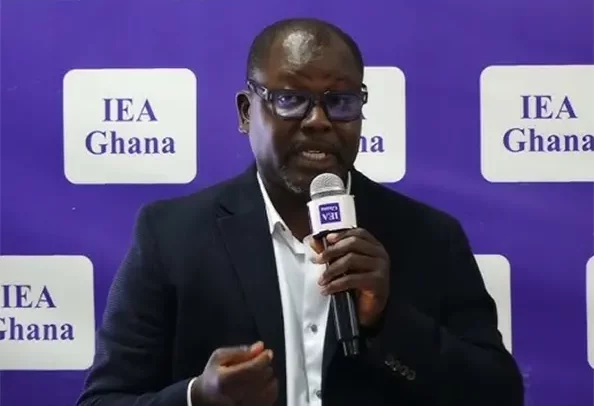

Professor Alexander Bilson Darku
The Institute of Economic Affairs (IEA) has rejected claims attributing a GH¢1.7 billion loss under the Bank of Ghana’s Domestic Gold Purchase Programme to the Ghana Gold Board (GoldBod).Geographic Reference
The Institute said much of the figure represents revenue and foreign-exchange valuation differences, not an actual loss.
Director of Research at the IEA, Professor Alexander Bilson Darku, said the reported amount comprised service fees, assaying fees and foreign-exchange valuation differences arising from GoldBod’s operations.
He explained that service and assaying fees were payments by the Bank of Ghana (BoG) to GoldBod for services rendered and therefore constituted revenue to GoldBod.
“I don’t understand why somebody would call revenue as a loss,” he said.
Prof. Darku spoke at the IEA’s assessment of the 2026 mid-year budget review on Wednesday, on the theme: “From Stabilisation to Transformation: An Assessment of Ghana’s 2026 Mid-Year Budget Review.”
He noted that about 90 percent of the GH¢1.7 billion was primarily an exchange-rate valuation issue.
“GoldBod purchased gold on behalf of BoG, with proceeds converted from US dollars into cedis using the Central Bank’s reference rate. Differences between the purchase rate and the valuation rate could appear as a loss in BoG’s books but did not necessarily represent depletion of national wealth.
“It is merely a book accounting issue, and not a significant loss to the nation,” he said.
Prof. Darku said transactions between two public institutions should be viewed from a broader government perspective.
“To the Government, its monetary authority, which is the Central Bank, has made that loss. To the Government, its Gold Board has made that gain,” he said, adding that the amounts could wash out at the broader government level.
He said GoldBod’s operations still required careful scrutiny, particularly as it transitions from BoG financing to private sector funding for gold purchases. If properly managed, he said, the model could deepen capital markets but required transparency and strong oversight.
He acknowledged GoldBod’s contribution to the economy through increased gold exports, foreign-exchange inflows and reserve accumulation, which had supported cedi stability.
He cautioned, however, against over-reliance on gold for exchange-rate stability, urging broader export promotion, import substitution, foreign-exchange market regulation and increased local ownership.
A Daily Guide Report