




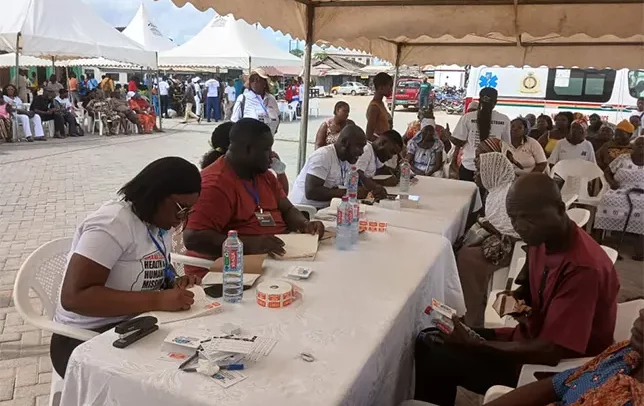
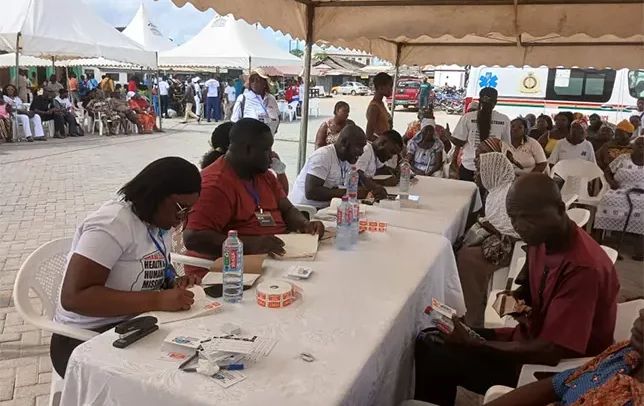
A scene during the health screening
The Impact World Health and Humanitarian Foundation (Impact World 360) has rolled out a community health outreach programme aimed at tackling rising cases of hypertension, stroke and other lifestyle-related diseases through education and medical support.
The initiative, led by its coordinator, Nana Adwoa Odeibea Noi, combines the donation of medical supplies with public health education to improve awareness and preventive care in underserved communities.
Speaking during the exercise, Ms. Odeibea Noi disclosed that the intervention was supported by donations from partners in the United States, including supplies from the Lloyd Moss Clinic, which recently shut down.
“We received a donation from a hospital that was closing down… they gave us about 10,000 syringes and other medical supplies,” she said.
She added that an ambulance was also donated by Kevin Dillard to support emergency response efforts.
“We needed an ambulance and it was donated to us to help improve emergency care within the communities,” she noted.
The foundation is also partnering with the National Ambulance Service and Ridge Hospital to strengthen healthcare delivery.
Ms. Odeibea Noi stressed that beyond donations, the outreach focuses heavily on prevention and health literacy, particularly in addressing hypertension and stroke.
“High blood pressure is chronic in our society… a significant number of people are affected, and many are having mini-strokes without even knowing,” she said.
“When people are told their blood pressure is 180 or 150, they often don’t understand what it means. So we are simplifying it using a traffic light system to help them know what is normal and what is dangerous,” she explained.
She expressed concern about poor dietary habits, linking them to the growing burden of chronic diseases.
“Our food choices are contributing to the problem. Some of the foods we consume have high sugar and salt content,” she stressed.
“Why are we not eating more of our natural foods like fruits? We need to go back to basics if we want to stay healthy,” she added.
The programme also includes the training of commercial motorbike riders as first responders under a community emergency response initiative.
“They are often the first to reach victims, especially in areas where vehicles cannot access. So we are training them in First Aid, Cardiopulmonary Resuscitation (CPR) and how to respond to emergencies,” she said.
According to her, the initiative is also aimed at transforming public perception about motorbike riders.
“They can be lifesavers if properly trained, and we want to empower them to support emergency care,” she noted.
The outreach further incorporates mental health support, with volunteers providing counselling and stress management guidance.
“People think mental health issues mean you are ‘crazy’, but stress and anxiety are real challenges we must address,” she added.
Ms. Odeibea Noi warned that younger people are increasingly at risk of lifestyle-related diseases.
“Stroke used to affect people over 50, but now we are seeing it in people as young as 30,” she stated.
“If the younger generation does not take care of their health, they will not be as healthy as those before them,” she cautioned.
She indicated that the foundation plans to extend the initiative to schools, colleges and universities to educate the youth on healthy living.
Describing the outreach as a pilot project, she said data gathered would inform future interventions.
“We are collecting data to understand the needs of the community so that when we return, we can provide more targeted support,” she stressed.
“This is just the beginning. Our goal is to make this sustainable and continue improving health outcomes in our communities,” she added.
By Vera Owusu Sarpong & Florence Adom Asamoah